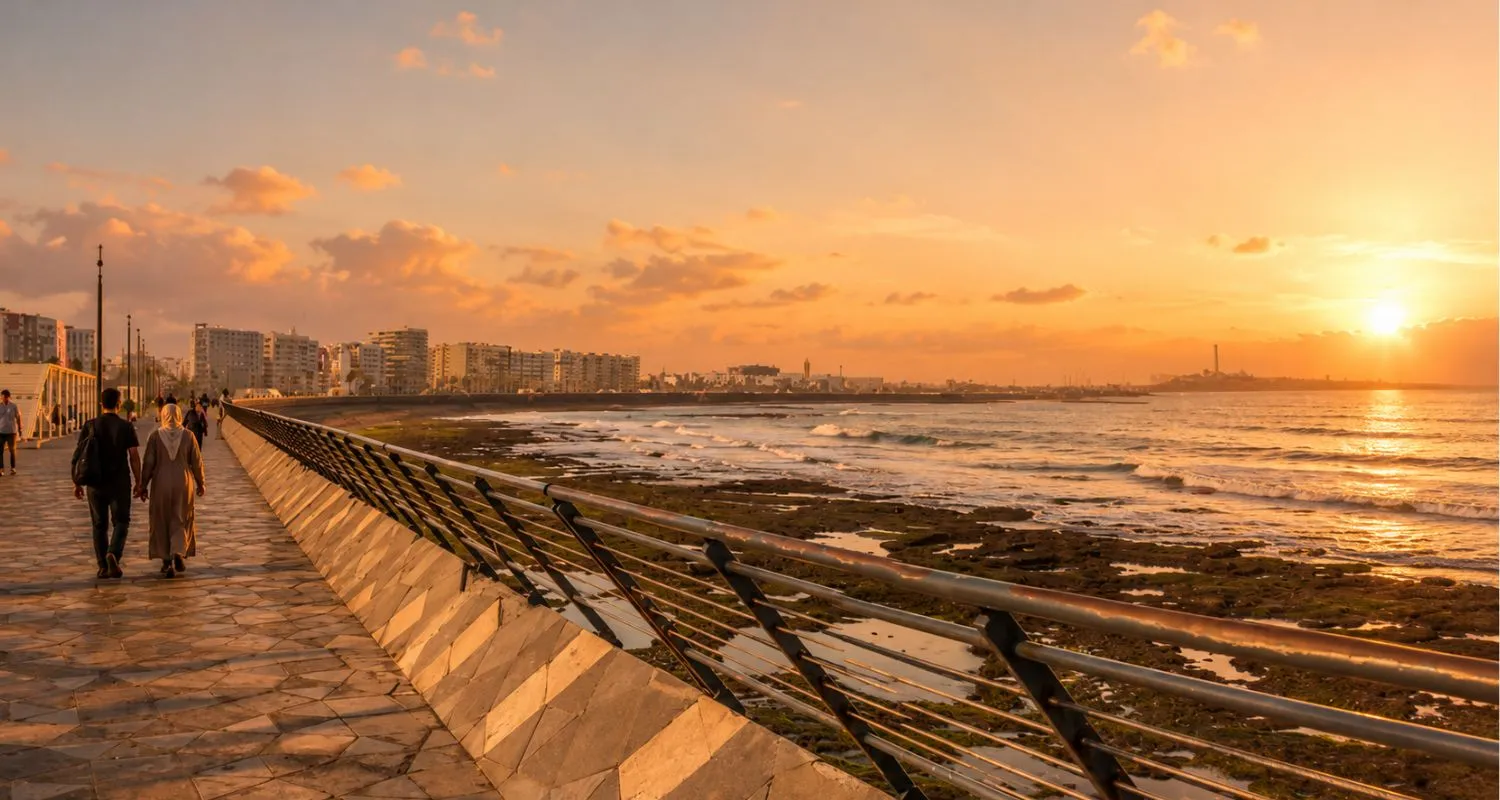
Skhirat Beach is a 1.5-kilometre stretch of golden sand on Morocco’s Atlantic coast, about 25 kilometres south of Rabat. It sits in the Skhirate-Témara prefecture, roughly halfway between the capital and Casablanca. Moroccan families fill it through the summer, mostly because the entry is shallow and the sandy bottom runs far out from shore.
Surfers head for the open sections, where modest waves roll in most of the year without much of a crowd. The beach has stayed local rather than turning into a resort strip, and that is the whole appeal.
Skhirat itself is a small town, so few people build an entire trip around it. The usual pattern is half a day on the sand and a bed back in Rabat, where the coastal hotels face the same Atlantic. STORY Le Carrousel is one of those, about half an hour up the coast.
Below you will find how to get there from Rabat, what the water is actually like, when to go, and what to know before you arrive.
What Is Skhirat Beach?
Skhirat Beach is the main public beach of Skhirat, a coastal town in Morocco’s Rabat-Salé-Kénitra region. The Rabat-Salé-Kénitra regional tourism board describes it as 1.5 kilometres of golden sand backed by dunes and palm trees. It is certified under the Blue Flag scheme, has a gradual entry over sand, and sits roughly 30 minutes by car from central Rabat.
A note on spelling: you will see both Skhirat and Skhirate. Skhirate is the official French administrative spelling, and both refer to the same town and beach.
Where Is Skhirat Beach Located?
The town sits on the Atlantic between Rabat and Casablanca, inside Skhirate-Témara prefecture, part of the wider Rabat-Salé-Kénitra region. Here is the detail that catches people out. The town centre sits about four kilometres inland from the sand, so arriving in Skhirat is not the same as arriving at the beach. Casablanca lies further down the same coast, roughly an hour away by motorway, and both cities feed this stretch on summer weekends.
What Makes Skhirat Beach Different From Other Beaches Near Rabat?
Témara, the next beach north, sits closer to the capital and stays consistently busier as a result. Agadir and Essaouira lie hundreds of kilometres south, pulling international crowds, large surf schools and full resort infrastructure. This beach works on a much smaller scale.
A named offshore feature, Skhirat Islet, sits just off the shoreline and gives the water a different character from the fully exposed beaches nearby. Surfers report a left-hander working off the rocks, though descriptions of the seabed differ from one source to the next. What you can count on is a gentler entry than the open breaks at Témara and a crowd that remains overwhelmingly Moroccan.

How Do You Get to Skhirat Beach From Rabat?
Driving from Rabat to Skhirat Beach takes about 30 minutes on the A3, while the train, grand taxi and app options each come with a specific catch worth knowing in advance.
By Car
The A3 motorway between Rabat and Casablanca has a signed Skhirate interchange, and that is the fastest way down. As published by Autoroutes du Maroc, the state motorway operator, a car pays 8 dirhams for the Rabat to Skhirate section, one of the cheapest tolls on the network. Tariffs do move, so treat that as the figure current in 2026.
Parking sits directly behind the beach and carries no official charge. Informal attendants will watch your car and expect a small coin for it, which is standard practice across Moroccan beaches and not a scam. In July and August the spaces closest to the sand fill by mid-morning, so an early start saves you a walk.
By Train
ONCF, the national rail operator, runs the TNR shuttle between Casablanca and Kénitra, and Skhirat is a scheduled stop on that line. From Rabat Ville or Rabat Agdal the ride takes roughly 20 to 25 minutes, with departures spread through the day. Timetables shift seasonally, so confirm current times before you commit.
Now for the part almost no guide mentions. The station sits in Skhirat town, four kilometres from this area, which means a petit taxi or a long walk in full sun. Budget for that last hop and rail becomes a genuinely good option.
By Grand Taxi or Ride-Hailing
Grand taxis work the Rabat to Skhirat Beach route as shared rides, filling with six passengers before they leave. Book the whole car and you pay roughly six times the single-seat price, but you move immediately. Agree the fare before the doors close, because negotiating afterwards never ends well.
Ride-hailing apps are a murkier story. Morocco’s Ministry of Transport rejected licence applications from inDrive, Careem and Yango in October 2025, and that decision has not been publicly reversed since. Drivers remain active in Rabat, so availability, pricing and legal standing all sit in a grey zone.
What Are the Best Things to Do at Skhirat Beach?
The activity list here is short, and that is rather the point. Skhirat Beach is not an adventure hub, so whatever it does offer, it offers without queues.
Swimming and Family Beach Days
Entry to the water is gradual and the bottom stays sandy well out from shore, which is why Moroccan families with small children pick this place over the rockier options nearby. Kids can wade a long way before the water reaches their chest, and low tide stretches that shelf even further out.
Weekday mornings in June feel close to empty. July and August weekends, by contrast, bring in what feels like half of Skhirate-Témara, so head for either end of the beach if space matters to you.

Surfing and Water Sports
Skhirat Beach is a beginner’s break, not a destination break. Surf-Forecast rates the spot around two out of ten for required skill, with rides under 50 metres and multiple peaks that rarely get crowded. A club based on the beach, the Association de Surf Skhirat Plage, runs lessons through the season, though you will need to message them on social media to confirm current sessions.
Now here is something most visitors get wrong. The surf peaks in winter, exactly when the beach itself is at its emptiest, and December delivers the most consistent clean days of the year. Jet skis and parasailing turn up over the summer, but operators come and go, so treat them as a bonus and not a plan.

Beachfront Cafés and Seafood
Cafés line the back of Skhirat Beach through the season, serving grilled sardines, tagines and mint tea at local prices. None of them carry famous names, which is normal for a beach that serves its own town instead of a tourist market. Vendors also work the sand with corn, doughnuts and cold drinks.
Terraces fill from late afternoon onward, since the sun sets straight over the Atlantic from this stretch of coast. During Ramadan the rhythm inverts completely: daytime service thins out and the beach fills after sunset. Because the Islamic calendar shifts about eleven days earlier each year and Morocco confirms the dates by local moon sighting, check before you travel.
When Is the Best Time to Visit Skhirat Beach?
The season at Skhirat Beach runs roughly May through October, though the two best months are not the two hottest.
Best Months and Sea Conditions
August is the warmest month on this coast. Long-run climate averages for the Rabat coastline put sea temperatures near 23°C and air highs around 30°C, which is as good as the Atlantic gets this far north.
September holds almost all of that warmth while the domestic crowds go home, and June works the same trick from the other direction. Here is how the season actually breaks down:
| Month | Sea temp | Air high | Crowds | Surf |
| June | ~21°C | ~27°C | Light | Small, clean mornings |
| July to August | 22 to 23°C | 29 to 30°C | Heaviest of the year | Smallest, most inconsistent |
| September | ~22.5°C | ~27.5°C | Light again after the first week | Picking up |
| October | ~21.5°C | ~25°C | Very light | Improving, shorter days |
Peak Moroccan holiday season lands squarely in July and August, and the two Eid holidays compress that pressure further wherever they fall. Both move through the calendar with the lunar year, so check the current dates before you fix a weekend. Eid al-Adha in particular tends to push a long weekend straight onto the coast.
Best Time of Day
Mornings before 11 a.m. give you flat water, clean surf and empty sand. Offshore winds tend to hold through the early hours, which is why the regulars are in the water before breakfast, and the surface gets noticeably choppier as the afternoon builds.
From about 6 p.m. the beach shifts from swimming to walking and eating. Sunset lands late in summer, close to 8 p.m. through July, so bring a layer: the ocean breeze pulls the temperature down fast once the light goes.
What Should You Know Before You Go?
Practical detail is where Skhirat Beach separates itself from the beaches around it, and also where most published guides go quiet.
Facilities and Amenities
This beach holds Blue Flag certification, the international standard covering water quality, safety, environmental management and visitor facilities. According to the Fondation Mohammed VI pour la Protection de l’Environnement, which administers the label in Morocco, all 28 beaches certified in 2025 had their certification renewed for 2026, and Skhirate was among them.
Morocco’s 2026 total reached a national record of 38 certified sites, made up of 33 beaches, four marinas and one mountain lake. Two of the five new beaches sit in Skhirat’s own prefecture: Contrebandiers and Sable d’Or.
In practice the label means the basic facilities are reliably available throughout the season instead of occasionally. Nothing here is luxurious, but everything below actually functions through the season.
- Parasols and sun loungers for rent, priced on the spot and dearer in August
- Changing cabins, toilets and freshwater showers
- Free parking behind the sand, watched by informal attendants
- Marked waste bins and daily cleaning as part of the Blue Flag standard
- Seasonal cafés with toilets available to customers, and vendors working the sand all afternoon
Safety, Currents and Lifeguards
Water quality is the reassuring half of the picture. Morocco’s Ministry of Energy Transition and Sustainable Development reported in April 2026 that over 95% of the country’s bathing waters met microbiological standards in 2025, monitored across 204 beaches and 498 sampling stations. Skhirat does not appear on the ministry’s non-compliance list.
Supervision is the half that needs your attention. The national beach surveillance campaign, run by the Direction Générale de la Protection Civile, covers 153 days from 1 May to 30 September. Outside that window, nobody is watching the water.
The numbers behind that campaign are worth reading. Civil protection recorded 9,413 people in difficulty on Moroccan beaches between May and July 2025, including 31 deaths, with neighbouring Témara named among the sharpest regional increases.
Rules that genuinely matter here:
- Swim within sight of the lifeguard post, not at the quiet ends of the beach
- Keep small children within arm’s reach even where the water is barely knee-deep
- Stay clear of the rocks and the islet side whenever the swell is up
- Treat late September with the same caution as August, because patrols thin out fast once the campaign winds down

What to Wear and Local Etiquette
Skhirat Beach draws a domestic crowd, not a resort crowd, and that changes what people wear. Moroccan women swim in everything from bikinis to full swimwear to street clothes, and all of it passes without comment.
Foreign visitors in standard swimwear are unremarkable. That said, the further you walk from the hotel stretch, the more conservative the crowd becomes, so we suggest packing a cover-up for the walk to the car or the café. Topless sunbathing is not done here, and photographing other people’s families without asking is the one thing that reliably causes friction.
What Else Is Worth Seeing Nearby?
Skhirat is a small town, so the surrounding area carries most of a full day out. Two things sit within a few minutes of the sand: a royal palace with a heavy history, and a conference centre that quietly shapes how busy the town gets. Rabat and Témara handle the rest, both close enough to reach before lunch.
Skhirat Royal Palace and the Mohammed VI Conference Centre
The Skhirat Royal Palace serves as a summer residence for the Moroccan royal family and stays closed to visitors, so you see it from the road and no closer. Its historical weight is considerable: on 10 July 1971, during King Hassan II’s 42nd birthday party, cadets from the Ahermoumou military academy stormed the palace in a failed coup that left hundreds dead, including dozens of civilian guests.
Next door, the Mohammed VI International Conference Centre still operates as a working venue with an auditorium, breakout rooms and an adjacent exhibition hall. Large conferences there can absorb most of the hotel inventory in town, so check the event calendar first if you intend to sleep in Skhirat.
Combining Skhirat Beach With Témara or Central Rabat
The cleanest one-day plan puts the beach first and the city second. Spend the morning at the beach while the water is still glassy, then drive north for a late lunch in Rabat. Témara sits directly on that route and adds a second beach if you want one, though it runs busier and less pleasant.
Rabat’s historic core is inscribed on the UNESCO World Heritage List as Rabat, Modern Capital and Historic City: a Shared Heritage, added in 2012. The Kasbah of the Udayas and the Hassan Tower both sit inside that property, and either one fills an afternoon comfortably. Give yourself two hours minimum if you want to walk the Kasbah properly.

Where Should You Stay?
You can sleep in Skhirat itself or base yourself in Rabat, and most visitors pick Rabat for a straightforward reason: it gives you a capital city and a coastline together, along with a far wider choice of restaurants and evening options.
Skhirat or Rabat: Which Base Makes More Sense?
Staying in Skhirat puts you on the sand and very little else. Evenings are quiet, restaurant choice is thin, and anything cultural means getting back in the car. For a two-night beach-only stop, that trade works perfectly well.
Rabat, by contrast, gives you Skhirat Beach as a day trip plus a UNESCO-listed medina, a serious restaurant scene and an airport close by. For anything longer than a weekend, the capital is the practical base.
STORY Le Carrousel Rabat
STORY Le Carrousel in Rabat sits directly above the Atlantic in the Yacoub El Mansour district, on the southwestern side of the city and the side closest to Skhirat. The building curves along the coastline, so most rooms and public areas open onto uninterrupted ocean.

Facilities cover an outdoor pool, the AZALA Spa with eight treatment rooms and a traditional hammam, and five dining and drinking venues including Solé by Casa Jose. The medina, the Kasbah of the Udayas and the Hassan Tower all sit within about fifteen minutes, while the drive south to Skhirat Beach takes roughly half an hour. That combination is what makes it work as a base for a beach day.
Is Skhirat Worth a Day Trip From Rabat?
Now that you have the full picture, the answer comes down to what you want from a beach. The half-hour out of Rabat pays off if you are after calm water, sand you can actually sit on, and a place that has not been rebuilt around visitors. Families and beginner surfers get the most out of it, particularly in June or September when the water stays warm and the crowds have thinned.
It will disappoint anyone expecting Agadir’s infrastructure or Essaouira’s atmosphere. Come for a morning, eat grilled sardines on your way out, and drive back with the afternoon still ahead of you. Skhirat Beach does not compete with Morocco’s famous coastline, and that is precisely the reason to go.